
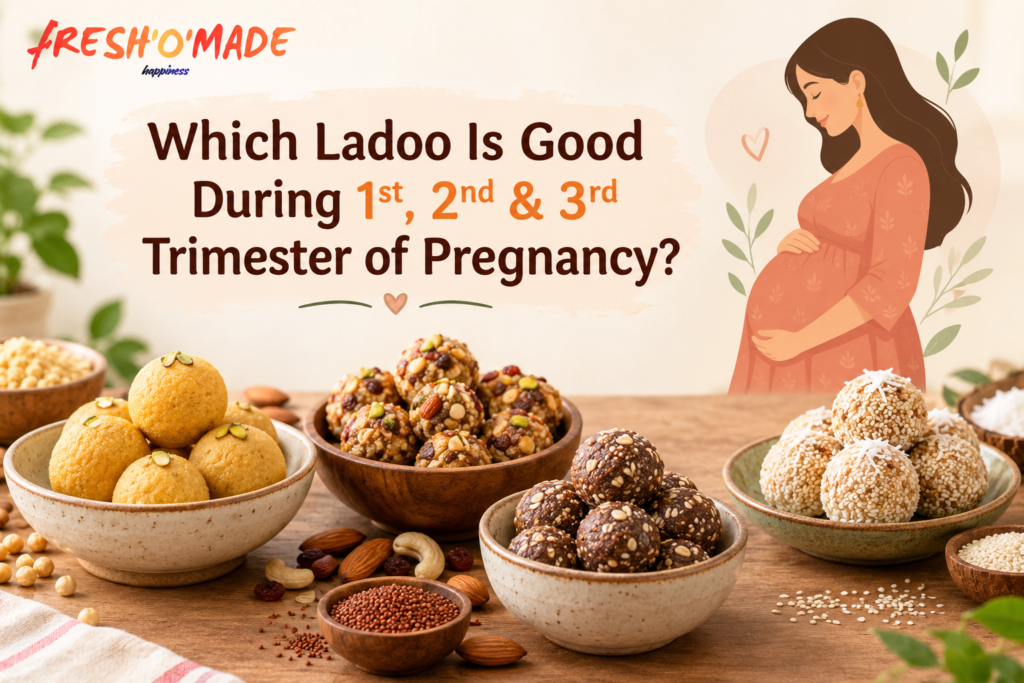
Pregnancy is a beautiful journey, and food becomes an important part of caring for both mother and baby. But can you eat ladoo during pregnancy? Which ladoo is suitable in the first trimester, second trimester and third trimester?
Traditional Indian ladoos are often made with ingredients such as nuts, peanuts, dates, grains, seeds, ghee and jaggery. Depending on the ingredients and portion size, some ladoos can fit into a balanced pregnancy diet.
However, there is no medically required ladoo for a particular trimester. Your nutritional needs change during pregnancy, but a healthy diet should remain varied rather than relying on one food.
This guide explains how dry fruit ladoo, peanut ladoo and other homemade ladoos may fit into pregnancy nutrition during the first, second and third trimesters.
«Important: This article is general food information, not individual medical advice. Pregnancy diets can vary depending on diabetes, allergies, anaemia, digestive problems, weight gain, medications and other medical conditions. Follow your obstetrician or qualified dietitian’s advice.»
Quick Answer: Which Ladoo Can You Eat During Each Trimester?
If you are looking for a simple answer:
| Pregnancy stage | Ladoo options to consider | Main consideration |
| 1st trimester | Dry fruit ladoo, peanut ladoo | Choose small portions and consider nausea or food aversions |
| 2nd trimester | Dry fruit ladoo, peanut ladoo, selected grain-based ladoos | Focus on variety and balanced nutrition |
| 3rd trimester | Dry fruit ladoo, peanut ladoo, selected homemade ladoos | Portion size and overall calorie intake become important |
| After delivery | Methi ladoo and other traditional postpartum ladoos | Consider ingredients, breastfeeding and individual health needs |
This does not mean that one ladoo is specifically required in one trimester.
NHS pregnancy guidance recommends a varied diet containing foods such as fruit and vegetables, starchy foods, protein foods including nuts and pulses, and dairy or suitable alternatives.
1st Trimester: Which Ladoo Can You Eat?
The first trimester covers the early part of pregnancy, when many women experience nausea, vomiting, changes in taste and smell, tiredness and food aversions.
During this stage, the most important thing is not finding a special “pregnancy ladoo.”
Instead, focus on foods that you can comfortably tolerate while maintaining a varied diet.
Dry Fruit Ladoo in the 1st Trimester
A dry fruit ladoo may contain almonds, walnuts, cashews, dates, raisins, seeds and ghee.
Nuts can be part of a healthy pregnancy diet. NHS guidance includes nuts among protein-containing foods suitable during pregnancy.
A small dry fruit ladoo can therefore be considered as an occasional energy-rich snack if the ingredients suit you.
However, some women experience nausea or digestive discomfort during early pregnancy. If the smell or richness of a ladoo makes you feel uncomfortable, there is no need to force yourself to eat it.
Possible advantages of dry fruit ladoo
Depending on its recipe, it can provide:
- Energy
- Protein from nuts
- Fats from nuts and ghee
- Fibre from nuts and dried fruits
- Nutrients naturally present in nuts and dried fruits
Freshomade option
If you are looking for a homemade option, Freshomade Dry Fruits Ladoo can be linked here from this article:
Freshomade Dry Fruits Ladoo → https://freshomade.com/product/dry-fruit-ladoo/
Keep the product link natural rather than adding multiple links to the same product page.
Peanut Ladoo in the 1st Trimester
Peanut ladoo is another traditional option made using roasted peanuts, jaggery and sometimes ghee or cardamom.
Peanuts are a source of protein and fats and can be included in pregnancy diets for women who tolerate them.
NHS guidance states that peanuts and other nuts are safe during pregnancy unless the woman has an allergy or has been advised by a doctor or midwife not to eat them.
When peanut ladoo may be a convenient snack
A small peanut ladoo can provide concentrated energy and may be convenient when you want something small between meals.
But remember that peanut ladoo can also contain jaggery and ghee, making it an energy-dense food.
Freshomade Peanut Ladoo → https://freshomade.com/product/peanut-ladoo/
2nd Trimester: Which Ladoo Can You Eat?
The second trimester is often a period when appetite and food tolerance change compared with early pregnancy.
This can be a good time to pay attention to overall diet quality rather than focusing on one particular food.
A balanced pregnancy diet should include different food groups.
Dry Fruit Ladoo in the 2nd Trimester
Dry fruit ladoo can be included as an occasional snack if it fits your individual diet.
The combination of nuts and dried fruits can provide energy, fats, protein and fibre.
However, a ladoo should complement—not replace—regular meals.
For example, your overall diet can include:
- Vegetables
- Fruits
- Whole grains
- Pulses
- Nuts and seeds
- Dairy or suitable alternatives
- Other protein-rich foods
- Adequate fluids
NHS guidance emphasizes getting a balance of different foods during pregnancy rather than following a special diet.
Peanut Ladoo in the 2nd Trimester
Peanut ladoo can also fit into a varied diet during the second trimester.
Peanuts provide plant protein and fats, while jaggery provides carbohydrate and sweetness.
But “made with jaggery” does not mean “sugar-free.”
This is particularly important for women who have gestational diabetes or have been advised to monitor blood glucose.
If you have gestational diabetes, ask your doctor or dietitian how a jaggery-based ladoo can fit into your individual meal plan.
3rd Trimester: Which Ladoo Can You Eat?
The third trimester begins around week 28. Nutritional needs continue to matter as pregnancy progresses.
It is a common misconception that a pregnant woman needs to eat very large amounts of food.
NHS guidance says there is no need to “eat for two”; additional energy requirements increase later in pregnancy rather than requiring double portions.
Dry Fruit Ladoo in the 3rd Trimester
A small portion of dry fruit ladoo can be enjoyed if it suits your diet.
Because nuts, dried fruits and ghee are energy-dense, portion size is important.
A ladoo should be viewed as a snack or sweet—not as a replacement for a complete meal.
Peanut Ladoo in the 3rd Trimester
Peanut ladoo can similarly be included if there is no peanut allergy or medical restriction.
It may provide protein and energy from peanuts, along with carbohydrates from jaggery.
Again, the recipe matters.
A peanut ladoo containing a large amount of jaggery and ghee will have a different nutritional profile from a recipe using smaller amounts.
Is Dry Fruit Ladoo Good During Pregnancy?
Dry fruit ladoo can be a nutritious addition to a balanced diet because its ingredients may include nuts, seeds and dried fruits.
But “healthy” does not mean unlimited.
The nutritional value depends on:
- Which nuts are used
- How much dried fruit is used
- Amount of ghee
- Amount of jaggery or sugar
- Portion size
- The woman’s overall diet
Nuts are included among pregnancy-friendly protein foods in NHS guidance.
Therefore, a homemade dry fruit ladoo can be one possible snack, but it should be considered within the complete diet.
Is Peanut Ladoo Good During Pregnancy?
For pregnant women who are not allergic to peanuts and have not been advised to avoid them, peanut ladoo can be included as part of a balanced diet.
Peanuts provide protein and fats.
The other ingredients also matter.
For example:
Peanuts + jaggery + ghee = a concentrated snack
That means eating several ladoos at once may provide considerably more energy and sugar than intended.
A smaller portion may be more appropriate for many people.
Can You Eat Different Ladoos During Different Trimesters?
Yes, a pregnant woman does not necessarily have to eat the same type of ladoo throughout pregnancy.
For example:
1st trimester
Choose foods that you tolerate comfortably.
Possible option:
Dry fruit ladoo or peanut ladoo in a small portion, provided the ingredients suit you.
2nd trimester
Continue focusing on dietary variety.
Possible options:
Dry fruit ladoo, peanut ladoo or another homemade ladoo made with suitable ingredients.
3rd trimester
Continue the same principle, with attention to portion size and overall dietary needs.
Possible options:
Dry fruit ladoo or peanut ladoo in moderation, depending on individual dietary requirements.
This is a food guide—not a medical prescription.
What About Methi Ladoo During Pregnancy?
This is an important distinction.
Methi ladoo is traditionally associated with postpartum food in some Indian households, but pregnancy is different from the period after delivery.
Fenugreek is used as a food ingredient and also as a herbal preparation. The amount matters.
The National Center for Complementary and Integrative Health states that fenugreek is not considered safe during pregnancy in amounts greater than those normally found in food and notes concerns about increased risk of birth defects.
Therefore, pregnant women should not start taking concentrated fenugreek, methi supplements or medicinal amounts of fenugreek simply because it is traditionally used in ladoos.
If a methi ladoo contains a significant amount of fenugreek, speak with your obstetrician before eating it during pregnancy.
What About Methi Ladoo After Delivery?
After childbirth, methi ladoo is traditionally prepared in some Indian families.
Recipes may contain:
- Methi/fenugreek
- Wheat flour
- Ghee
- Jaggery
- Almonds
- Cashews
- Other nuts
- Spices
It can be an energy-rich traditional food.
However, it should not automatically be considered a medicine or guaranteed way to increase breast milk.
NCCIH notes that studies of fenugreek for increasing milk supply have had mixed results.
If a breastfeeding mother is considering concentrated fenugreek preparations, especially while taking medication, discussing it with a healthcare professional is sensible.
Ladoo During Pregnancy: What Should You Check?
Before buying or preparing ladoos during pregnancy, check the ingredients.
1. Allergies
Check for peanuts, almonds, cashews and other nuts.
2. Sweetener
Jaggery is still a source of sugar. It should not be treated as a sugar-free ingredient.
3. Ghee
Ghee adds flavour and energy but also increases the calorie density of the ladoo.
4. Portion Size
Even nutritious ingredients can contribute substantial calories when eaten in large quantities.
5. Freshness and Storage
Homemade products should be stored correctly and consumed according to their recommended shelf life.
Ladoo and Gestational Diabetes
If you have gestational diabetes, don’t assume that a ladoo made with jaggery is suitable simply because it is homemade.
Jaggery, dates and dried fruits still contribute carbohydrates and sugars.
Your doctor or registered dietitian can help you decide how such foods fit into your individual eating plan.
This is one reason why a pregnancy food article should not simply label every traditional ladoo as “healthy.”
Freshomade Ladoo Options
If you are reading this article because you are looking for homemade traditional ladoos, Freshomade offers several products that can be naturally connected with this topic.
Freshomade Dry Fruits Ladoo
A traditional ladoo made around dry fruits and nuts.
Add your product link:
“[Freshomade Dry Fruits Ladoo]”
Freshomade Peanut Ladoo
A traditional peanut-based ladoo that can be considered as an occasional snack for people who tolerate peanuts.
Add your product link:
Freshomade Besan Ladoo
Besan ladoo is another traditional Indian sweet that can be mentioned as part of a broader homemade-ladoo collection.
Add your product link:
Freshomade Urad Dal Ladoo
Urad dal ladoo is another traditional variety that can be explored separately.
Add your product link:
Freshomade Methi Ladoo
For your postpartum-related content, you can link your Methi Ladoo / Dink Methi Ladoo product page from a separate section about traditional postpartum foods.
Add your product link:
A Simple Pregnancy Ladoo Guide
Here is the easiest way to remember it:
1st Trimester → Choose what you tolerate
Dry fruit ladoo or peanut ladoo can be an occasional option if the ingredients suit you.
2nd Trimester → Focus on variety
Continue with a balanced diet and enjoy suitable ladoos in sensible portions.
3rd Trimester → Continue balance and portion control
Dry fruit or peanut ladoo can remain an occasional snack if suitable for you.
After Delivery → Traditional postpartum foods
Methi ladoo may be included according to individual needs and professional advice, particularly when breastfeeding or taking medication.
Frequently Asked Questions
Which ladoo is good in the first trimester?
There is no single ladoo recommended for every woman in the first trimester. Dry fruit or peanut ladoo can be considered as occasional snacks if the ingredients are suitable and tolerated.
Which ladoo is good in the second trimester?
Dry fruit ladoo and peanut ladoo can be included in a varied diet for many women. Portion size and the overall diet are important.
Which ladoo is good in the third trimester?
Dry fruit and peanut ladoos can be occasional snack options when suitable. They should not replace balanced meals.
Can I eat peanut ladoo during pregnancy?
Peanuts are generally safe during pregnancy unless you have an allergy or have been advised by your healthcare professional to avoid them.
Can I eat dry fruit ladoo during pregnancy?
Yes, dry fruit ladoo can fit into a balanced diet for many pregnant women. However, nuts, dried fruits and ghee can make ladoos energy-dense, so portion size matters.
Can I eat methi ladoo during pregnancy?
Extra caution is needed because concentrated amounts of fenugreek are not considered safe during pregnancy. If the ladoo contains a significant amount of methi, consult your obstetrician before eating it.
Which ladoo is best after delivery?
Methi ladoo is a traditional postpartum food in some Indian households, while dry fruit and other homemade ladoos are also used. There is no single ladoo that is medically best for every new mother.
Does methi ladoo increase breast milk?
Fenugreek has traditionally been used for lactation, but available evidence is mixed. It should not be presented as a guaranteed way to increase breast milk.
Final Thoughts
So, which ladoo is good during the 1st, 2nd and 3rd trimester?
The answer is not one particular ladoo.
During pregnancy, dry fruit ladoo and peanut ladoo can be included as occasional foods when their ingredients are suitable, there are no relevant allergies or medical restrictions, and portions are appropriate.
The bigger picture matters more than the ladoo itself. A pregnancy diet should include a variety of vegetables, fruits, whole grains, protein foods, nuts and other nutrient-rich foods.
And when it comes to methi ladoo, remember that pregnancy and postpartum nutrition are different. Concentrated fenugreek should be avoided during pregnancy unless specifically advised by a healthcare professional.
Traditional ladoos can certainly have a place in Indian food culture—but they work best as one small part of a balanced diet, not as a replacement for medical nutrition advice.
Freshomade brings traditional homemade ladoos and snacks to customers looking for familiar Indian flavours. Explore the Freshomade collection of Dry Fruits Ladoo, Peanut Ladoo, Besan Ladoo, Urad Dal Ladoo and Methi Ladoo through the relevant product pages.
This article is for general educational information and is not a substitute for advice from your obstetrician, doctor or registered dietitian.SEO details for this article